Choosing between corrugated and wooden packaging is an important decision for manufacturers. The right packaging can protect products during handling and transportation, improve storage efficiency, reduce avoidable damage, and support a more consistent supply chain.
But there is no universal answer to the question: Is corrugated packaging better than wooden packaging?
The right choice depends on your product, weight, dimensions, fragility, transportation distance, handling conditions, stacking requirements, storage environment, and export requirements.
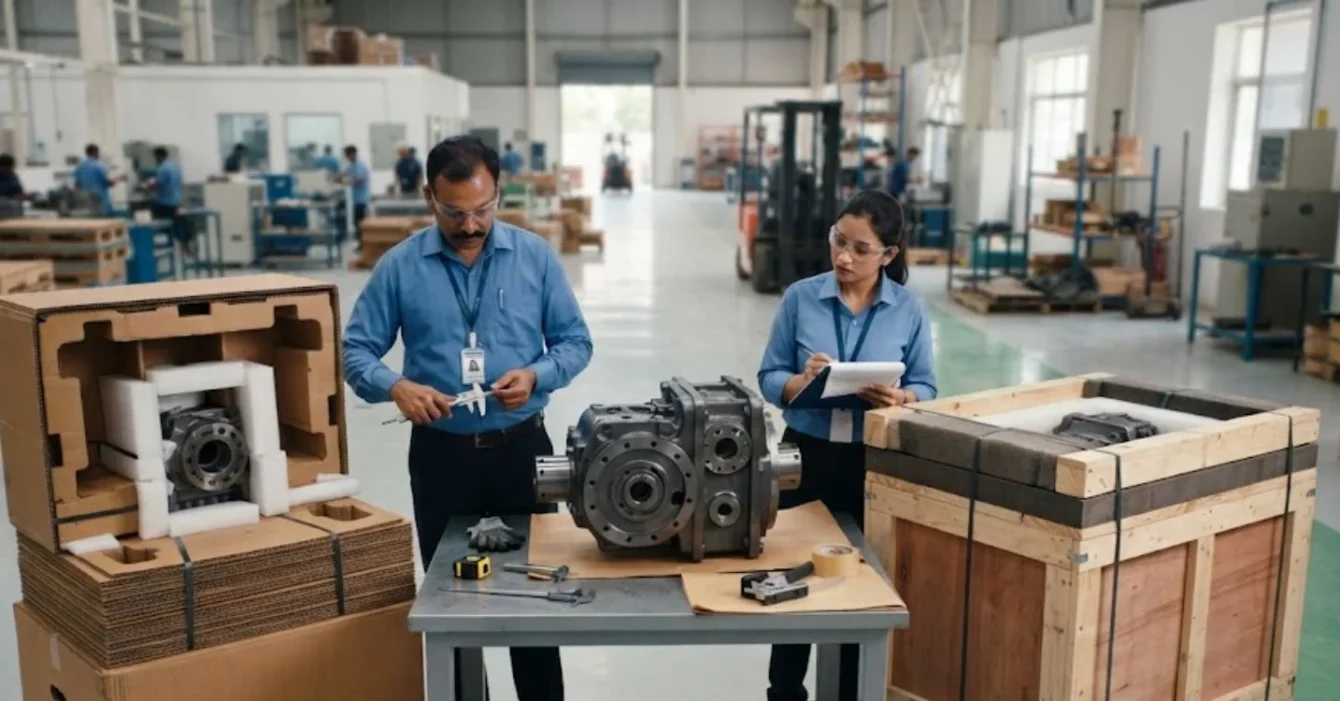
For some industrial products, heavy-duty corrugated packaging provides the right combination of protection, efficiency, and handling convenience. For heavy, oversized, irregular, or high-value products, wooden or plywood packaging may provide the structural strength required.
In many cases, the best solution is not corrugated or wooden packaging—but a combination of both.
For manufacturers looking for industrial packaging solutions in Delhi NCR, Faridabad, or across India, understanding the difference between these packaging systems can help you make a more informed decision.
What Is Corrugated Packaging?
Corrugated packaging is made using layers of paper-based material designed to create a lightweight but structurally effective packaging system.
For industrial applications, corrugated packaging can be engineered into much more than a standard carton.
It can include:
- Heavy-duty corrugated boxes
- Industrial cartons
- Corrugated sleeves
- Die-cut structures
- Partitions
- Internal fitments
- Dividers
- Protective inserts
- Custom-designed corrugated assemblies
The structure can be developed around the product’s dimensions, weight, handling conditions, and protection requirements.
For many manufactured components, corrugated packaging offers an effective balance between protection, material efficiency, handling, storage, and cost.
What Is Wooden Packaging?
Wooden packaging uses timber, plywood, or related structural materials to create packaging systems designed for heavier or more demanding applications.
Common wooden packaging formats include:
- Wooden pallets
- Wooden boxes
- Plywood boxes
- Crates
- Skids
- Structural bases
- Heavy-duty export packaging
Wooden packaging is often selected when the product requires greater structural support or when the packaging needs to withstand heavier loads and demanding handling conditions.
It can be particularly useful for machinery, heavy engineering components, industrial equipment, oversized products, and irregularly shaped loads.
Corrugated vs Wooden Packaging: The Key Difference
The biggest difference between the two is their structural behaviour and typical application.
Corrugated packaging generally provides a lighter and more flexible packaging solution, while wooden packaging provides greater structural rigidity for demanding loads.
However, material strength alone should not determine the decision.
The packaging must be matched to the product and the supply-chain conditions.
A lightweight product does not necessarily require a wooden box.
Similarly, a heavy product cannot automatically be placed in a corrugated carton simply because the carton is rated for the weight.
The packaging structure, internal support, handling requirements, and transportation conditions all matter.
When Should You Choose Corrugated Packaging?
Corrugated packaging can be a strong choice when the product requires structured protection without the additional weight and rigidity of a wooden packaging system.
It can work well for products such as:
- Automotive components
- Electrical components
- Industrial parts
- Small and medium-sized assemblies
- Manufactured components
- Solar and renewable energy components
- Repeated production-line shipments
The specific design can include internal fitments, partitions, cushioning, and product-specific structures.
1. When Weight Is Moderate
Corrugated packaging can be appropriate for products where the packaging does not need to carry extremely heavy loads.
The structure can be engineered according to the product’s weight and stacking requirements.
2. When Handling Efficiency Matters
Corrugated packaging is generally easier to handle than heavier wooden packaging.
This can be useful where packages are frequently moved manually or where reducing packaging weight is an operational consideration.
3. When Storage Space Matters
Corrugated packaging can be designed for efficient storage, particularly when flat-packed components are assembled only when required.
This can help manufacturers manage warehouse space more effectively.
4. When Internal Fitment Is Important
Corrugated packaging can be engineered with product-specific internal structures.
Partitions, die-cut inserts, sleeves, and fitments can help prevent product movement and protect sensitive components.
5. When Repeated Packaging Is Required
For manufacturers shipping similar components repeatedly, a standardized corrugated packaging system can create greater consistency across production batches.
This can help improve packing operations and reduce variation.
When Should You Choose Wooden Packaging?
Wooden or plywood packaging becomes more suitable when the product requires significant structural support.
This may include:
- Heavy machinery
- Capital equipment
- Large engineering components
- Oversized products
- Irregularly shaped products
- Heavy assemblies
- Export shipments
- High-value industrial equipment
1. When the Product Is Heavy
Heavy products may place significant structural demands on the packaging.
Wooden bases, pallets, skids, and boxes can provide the support required for heavier loads.
2. When the Product Is Oversized
Large products can be difficult to accommodate within standard corrugated packaging formats.
Wooden packaging can provide greater flexibility when designing a structural enclosure around oversized equipment.
3. When the Load Is Irregular
Products with unusual shapes or uneven weight distribution may require custom structural support.
Wooden or plywood structures can be engineered around the product’s specific geometry and load-bearing points.
4. When Heavy Handling Equipment Is Used
If a product is moved using forklifts, cranes, or other material-handling equipment, the packaging may need dedicated lifting and support points.
Wooden pallets, skids, and structural bases can be designed with handling requirements in mind.
Corrugated vs Wooden Packaging: A Practical Comparison
| Requirement | Corrugated Packaging | Wooden/Plywood Packaging |
|---|---|---|
| Lightweight products | Excellent | Usually unnecessary |
| Moderate-weight products | Suitable | Suitable |
| Heavy products | Application dependent | Often preferred |
| Oversized products | Limited by structure | Highly suitable |
| Irregular loads | Application dependent | Highly suitable |
| Internal fitments | Excellent | Possible |
| Manual handling | Easier | More demanding |
| Heavy-duty structural support | Limited/application dependent | Excellent |
| Export applications | Suitable depending on design | Common for heavy export loads |
| Storage efficiency | Generally good | Depends on design |
| Complete packaging assemblies | Excellent | Excellent |
The important point is that this table should be treated as a starting point, not a replacement for packaging engineering.
What About Product Protection?
The choice between corrugated and wooden packaging should also consider the type of damage you are trying to prevent.
Different products face different risks.
Impact Damage
If the product is vulnerable to impact, the packaging may require cushioning, blocking, bracing, or internal fitments.
The outer material alone does not determine protection.
Product Movement
If the product can move inside the package, both corrugated and wooden packaging may require product-specific internal structures.
Surface Damage
Finished metal components may require wrapping, surface protection, VCI materials, or other protective layers.
Moisture and Corrosion
Neither corrugated nor wooden packaging automatically solves corrosion risk.
For moisture-sensitive products, the packaging system may need:
- VCI protection
- Moisture barriers
- Protective wrapping
- Desiccants
- Sealed packaging
The right solution depends on the product and transportation environment.
When Corrugated and Wooden Packaging Work Together
One of the biggest misconceptions is that manufacturers must choose only one packaging material.
In many industrial applications, a combination provides better overall performance.
For example, a packaging system could include:
Wooden pallet + corrugated outer structure + internal corrugated fitments + VCI protection
This combination can provide:
- Structural support from wood
- Product-specific protection from corrugated fitments
- Improved surface protection
- Easier product positioning
- Better handling compatibility
This type of complete packaging assembly is particularly useful when one material alone cannot address all the packaging requirements.
An experienced industrial packaging solutions company can evaluate the complete system rather than recommending a single material in isolation.
Corrugated vs Wooden Packaging for Export
Export shipments often require additional consideration because the product may travel through multiple handling points and remain in transit or storage for extended periods.
The packaging may need to withstand:
- Long-distance transportation
- Repeated loading and unloading
- Stacking
- Warehouse storage
- Humidity
- Moisture exposure
- Different handling environments
- International shipping requirements
When wooden packaging is used for international shipments, applicable ISPM-15 requirements should be considered.
Export packaging should therefore be designed around the complete journey rather than the initial dispatch stage.
For manufacturers in Delhi NCR and other major industrial regions, working with an experienced export packaging solutions provider can simplify these considerations.
Which Is More Cost-Effective: Corrugated or Wooden Packaging?
Cost should be evaluated across the entire packaging system rather than by comparing the price of one box against one wooden crate.
Corrugated packaging may offer cost advantages for many moderate-weight products, especially where packaging is produced repeatedly at scale.
Wooden packaging may have a higher initial material and handling cost, but it can be appropriate when the product requires substantial structural protection.
The real cost of packaging should consider:
- Packaging material
- Labour
- Assembly time
- Storage
- Transportation weight
- Product damage
- Returns
- Rework
- Replacement costs
- Disposal or recovery
- Packaging consistency
A cheaper package that results in repeated product damage is not necessarily a cost-effective solution.
How to Select the Right Industrial Packaging Solution
Before choosing corrugated or wooden packaging, evaluate these factors:
Product Weight
How heavy is the product, and how is the weight distributed?
Product Dimensions
What are the length, width, height, and overall geometry?
Fragility
Which components are sensitive to impact, vibration, or pressure?
Surface Finish
Does the product require protection against scratches, contamination, or corrosion?
Transportation
Will it travel by road, rail, sea, or air?
Handling
Will it be handled manually, by forklift, or using lifting equipment?
Stacking
Will multiple packages be stacked during transportation or storage?
Storage Duration
How long will the product remain packed?
Environmental Conditions
Could the package encounter rain, humidity, condensation, dust, or temperature changes?
Export Requirements
Is the product being shipped internationally?
Answering these questions provides a much stronger foundation for selecting the packaging structure.
Why Work With an Engineered Industrial Packaging Partner?
The biggest advantage of working with an experienced packaging partner is that you do not have to make the material decision in isolation.
Instead of asking:
“Should I buy corrugated or wooden packaging?”
the better question is:
“What packaging system will protect my product throughout its journey?”
An engineering-led packaging partner can analyse the application and determine whether the solution should use corrugated packaging, wooden packaging, protective materials, or a combination.
This can also reduce the need to coordinate multiple packaging vendors.
For manufacturers searching for an industrial packaging company in Delhi NCR, packaging solutions in Faridabad, or a packaging partner in Delhi, an integrated approach can make packaging procurement and coordination simpler.
Green Packs: Engineered Industrial Packaging Solutions
Green Packs designs packaging around the product and its supply-chain requirements.
Our packaging capabilities include:
- Corrugated Packaging Systems
- Wooden & Plywood Packaging
- Protective Packaging
- Complete Packaging Assemblies
Our approach begins by understanding the product, its dimensions, weight, handling conditions, transportation requirements, stacking needs, and environmental exposure.
We work with manufacturers across:
- Automotive and auto components
- Renewable energy and solar
- Engineering and capital goods
- Electrical and industrial equipment
- Export-oriented manufacturing
With manufacturing facilities across Faridabad, Bhiwadi, Chennai, Pune, and Jaipur, Green Packs supports industrial packaging requirements across multiple manufacturing locations.
Whether your requirement is heavy-duty corrugated packaging, wooden export packaging, protective packaging, or a complete engineered packaging assembly, the objective remains the same: create the right level of protection for the product and its journey.
Conclusion
So, corrugated vs wooden packaging—which solution is right for your product?
There is no universal answer.
Corrugated packaging can be an excellent option for many industrial products requiring structured protection, efficient handling, internal fitments, and material efficiency.
Wooden and plywood packaging can be more appropriate for heavy, oversized, irregular, or structurally demanding products.
And in many cases, the best answer is a combination of both.
The right packaging should be selected based on the product, transportation conditions, handling requirements, stacking, environmental exposure, protection needs, and total packaging cost—not simply the material price.
If you are evaluating corrugated vs wooden packaging for your industrial product, start with the product itself.
Understand its risks.
Understand its journey.
Then engineer the packaging around it.
Looking for the right industrial packaging solution in Delhi NCR or Faridabad?
Discuss Your Packaging Requirement with Green Packs and find a packaging system designed around your product.