Choosing the right packaging for an industrial product is not simply about selecting a box, pallet, or wrapping material that fits. Industrial products often have different weights, dimensions, fragility levels, surface finishes, handling requirements, storage conditions, and transportation routes. The right packaging must protect the product throughout its entire supply-chain journey.
This is why engineered industrial packaging solutions are becoming increasingly important for manufacturers across automotive, renewable energy, engineering, electrical equipment, and export manufacturing.
The right industrial packaging solution can help reduce transit damage, improve handling efficiency, protect products from moisture and corrosion, optimize material usage, and create greater consistency across shipments.
So, how do you choose the right industrial packaging for your product?
The answer starts with the product itself.
What Is Industrial Packaging?
Industrial packaging refers to packaging systems designed to protect products during handling, storage, transportation, and delivery. Unlike standard consumer packaging, industrial packaging often needs to handle heavier loads, repeated movement, long-distance transportation, stacking, environmental exposure, and specialized handling conditions.
Depending on the application, industrial packaging can include:
- Heavy-duty corrugated boxes and cartons
- Corrugated sleeves and die-cut structures
- Wooden and plywood boxes
- Industrial pallets and skids
- Internal fitments and cushioning
- VCI packaging for corrosion protection
- Moisture barriers and protective films
- Wrapping and surface protection
- Export packaging systems
- Complete packaging assemblies
The best solution is not necessarily the strongest or most expensive option. It is the solution that provides the required level of protection while also considering cost, handling, storage, sustainability, and supply-chain requirements.
1. Start With Your Product
The first step in selecting custom industrial packaging is understanding the product being packaged.
Every product has different packaging requirements. A lightweight electrical component may need shock and moisture protection, while a heavy engineering component may require a rigid wooden base and reinforced structural support.
Before designing the packaging, consider:
- Product dimensions
- Product weight
- Centre of gravity
- Shape and geometry
- Fragile or sensitive components
- Surface finish
- Sharp edges or projections
- Corrosion sensitivity
- Load-bearing areas
- Stacking requirements
- Handling method
Packaging should be designed around these characteristics rather than forcing the product into a standard packaging format.
This product-first approach is at the heart of engineered industrial packaging solutions.
2. Understand the Supply-Chain Journey
A package does not experience only one type of movement.
During its journey from the production line to the customer, a product may be lifted, stacked, transported, stored, loaded, unloaded, and handled multiple times.
That means your industrial packaging solutions need to account for the complete journey.
Ask questions such as:
- Will the product travel by road, rail, sea, or air?
- How many times will it be loaded and unloaded?
- Will packages be stacked?
- How long will the product remain in storage?
- Will it be transported domestically or internationally?
- Will forklifts or cranes be used?
- Could the package experience vibration or impact?
- Will it be exposed to rain, humidity, dust, or temperature changes?
A package designed only for the factory floor may not perform adequately during long-distance transportation.
Understanding the complete supply chain allows an industrial packaging solutions company to design protection around actual handling and transportation conditions.
3. Select the Right Packaging Material
There is no single material that works for every industrial application.
The right material depends on the product, load, transportation conditions, protection requirements, and packaging objectives.
Corrugated Packaging
Heavy-duty corrugated packaging is suitable for many industrial components and manufactured products. Depending on the design, corrugated packaging can include cartons, boxes, sleeves, partitions, die-cut structures, and internal fitments.
It can provide a practical balance between protection, handling, storage, and material efficiency.
Wooden & Plywood Packaging
Wooden and plywood packaging is often considered for heavy, oversized, irregular, or high-value products that require greater structural support.
Applications can include:
- Industrial equipment
- Heavy engineering components
- Machinery
- Large assemblies
- Export shipments
- Heavy or irregular loads
Wooden pallets, boxes, skids, and structural bases can be engineered according to the product and handling requirements.
Protective Packaging
Some products require protection beyond structural packaging.
VCI materials, moisture barriers, wrapping materials, and surface protection can help address corrosion, contamination, moisture, and surface damage.
For products with sensitive metal surfaces, choosing the right protective packaging can be just as important as choosing the outer container.
Complete Packaging Assemblies
In many cases, one material alone is not enough.
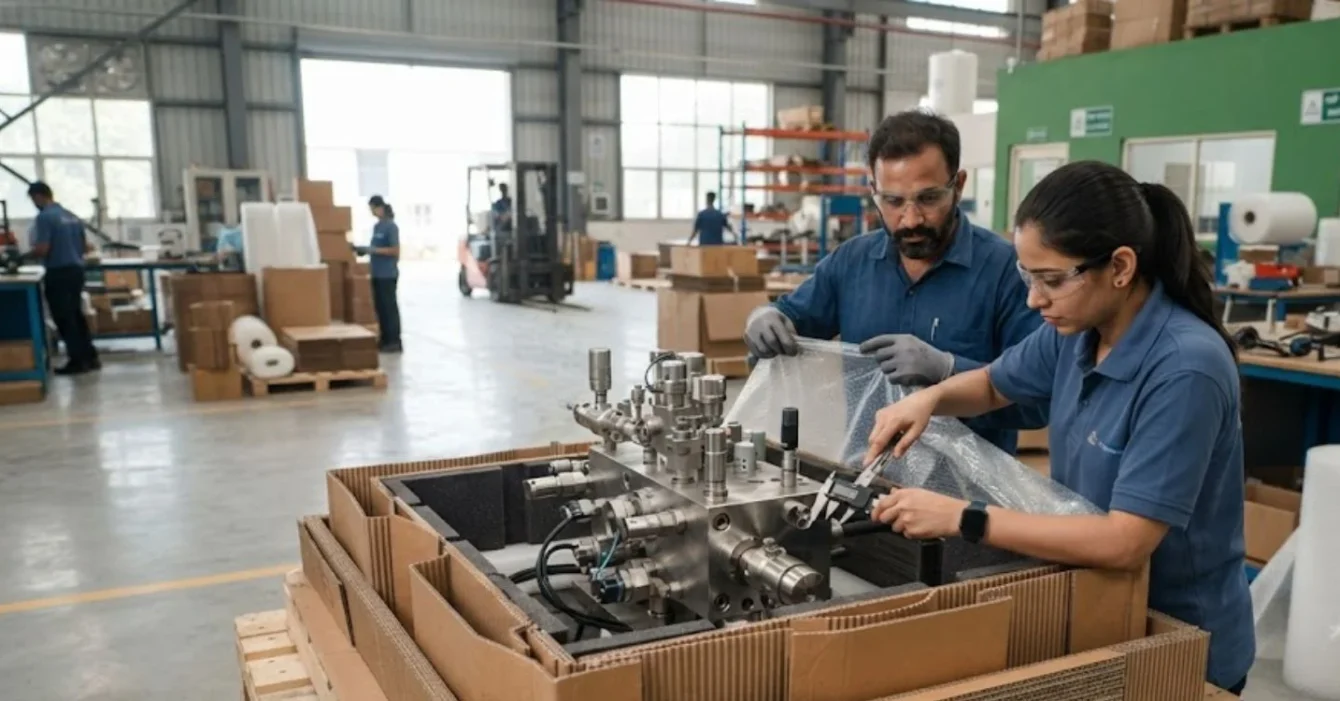
A complete industrial packaging assembly may combine corrugated structures, wooden bases, protective layers, internal fitments, and moisture or corrosion protection.
This approach creates a packaging system designed around the product rather than a collection of individual packaging materials.
4. Consider Product Movement Inside the Package
One of the most common causes of packaging-related damage is product movement.
Even when the outer container can carry the product’s weight, uncontrolled movement inside the package can result in:
- Surface scratches
- Impact damage
- Component movement
- Edge damage
- Deformation
- Breakage
- Poor presentation at delivery
Internal fitments, partitions, blocking, bracing, cushioning, and product-specific structures can help control movement.
The goal is not simply to fill empty space. The internal packaging should position and protect the product appropriately throughout handling and transportation.
This is where custom industrial packaging can provide an advantage over standard packaging.
5. Evaluate Stacking and Load Distribution
Industrial packages are frequently stacked during transportation or storage.
A packaging design that performs well individually may fail when multiple packages are stacked.
Before finalizing your packaging design, consider:
- Maximum stacking height
- Package orientation
- Load-bearing points
- Pallet configuration
- Weight distribution
- Compression requirements
- Warehouse storage conditions
Poor load distribution can lead to crushed cartons, damaged products, unstable stacks, or handling problems.
Engineered packaging considers the relationship between the product, package structure, pallet, and stacking arrangement.
6. Protect Against Moisture and Corrosion
For metal components and other moisture-sensitive products, environmental protection is an important part of packaging design.
Humidity, condensation, rain, and prolonged storage can create corrosion risks.
Depending on the application, the packaging system may require:
- VCI protection
- Moisture barriers
- Protective wrapping
- Sealed packaging
- Desiccant solutions
- Appropriate outer packaging
The right approach depends on the product material, storage duration, transportation conditions, and environmental exposure.
For export-oriented manufacturers, corrosion protection can become especially important because products may spend extended periods in transit or storage.
7. Think About Handling Requirements
Packaging should make the product easier and safer to handle.
Consider how the package will be moved at every stage.
Will it be handled manually?
Will a forklift be used?
Does it require lifting points?
Can the package be safely stacked?
Does the pallet configuration work with the customer’s warehouse?
Does the package fit existing handling equipment?
These questions can influence the structural design, pallet dimensions, access points, weight distribution, and overall configuration.
Good industrial packaging solutions protect the product while also supporting efficient handling.
8. Balance Protection With Packaging Cost
More material does not automatically mean better packaging.
Over-engineered packaging can increase:
- Material consumption
- Packaging cost
- Storage requirements
- Transportation weight
- Disposal requirements
- Handling effort
Under-engineered packaging can result in product damage, returns, rework, replacement costs, and customer dissatisfaction.
The objective is to find the right balance between protection and efficiency.
A properly engineered packaging system uses the appropriate materials and structure for the actual risk involved.
This is one reason manufacturers often work with an industrial packaging solutions company rather than simply purchasing standard packaging products.
9. Consider Export Packaging Requirements
If your products are being shipped internationally, packaging requirements become more complex.
Export shipments can involve multiple handling points and longer transportation durations. Wooden packaging may also need to meet applicable international requirements.
For export-oriented manufacturers, packaging should be considered in relation to:
- International transportation
- Multiple handling points
- Long transit durations
- Moisture exposure
- Stacking
- Customs and shipping requirements
- Wood packaging compliance
Where wooden packaging is used for international shipments, ISPM-15 compliance may be required depending on the destination and applicable regulations.
An experienced packaging partner in India can help manufacturers consider these requirements during the packaging design stage.
10. Prototype and Validate Before Production
One of the most effective ways to reduce packaging problems is to validate the design before moving into large-scale production.
A prototype can help identify:
- Fitment issues
- Product movement
- Handling difficulties
- Structural weaknesses
- Material requirements
- Assembly challenges
- Storage problems
Instead of discovering a design problem after hundreds or thousands of packages have been manufactured, prototyping gives manufacturers an opportunity to improve the packaging beforehand.
Where appropriate, packaging can also be evaluated against real handling and transportation conditions.
11. Choose a Packaging Partner, Not Just a Supplier
The difference between a packaging supplier and an industrial packaging solutions company is often the approach taken toward the problem.
A supplier may provide a standard product.
A packaging partner looks at the product, understands the supply chain, evaluates risks, engineers the packaging, prototypes the solution, and coordinates manufacturing.
For manufacturers managing multiple packaging materials, having one partner can also simplify procurement and coordination.
Instead of managing separate vendors for corrugated packaging, wooden packaging, and protective materials, an integrated packaging partner can coordinate multiple elements of the final packaging system.
How Green Packs Approaches Industrial Packaging
At Green Packs, packaging starts with understanding the product and its journey.
Our engineering-led approach considers product dimensions, weight, fragility, handling conditions, transportation, storage, stacking, and protection requirements before developing the packaging structure.
Our capabilities cover:
- Corrugated packaging systems
- Wooden and plywood packaging
- Protective packaging
- Complete packaging assemblies
We work with manufacturers across automotive and auto components, renewable energy and solar, engineering and capital goods, electrical and industrial equipment, and export-oriented manufacturing.
With manufacturing facilities across Faridabad, Bhiwadi, Chennai, Pune, and Jaipur, Green Packs supports packaging requirements across multiple industrial locations.
Final Thoughts: The Right Packaging Starts With the Product
Choosing the right industrial packaging is not about selecting the biggest box, the strongest pallet, or the most material.
It is about understanding the product and designing protection around its actual supply-chain journey.
The right packaging solution should consider product characteristics, transportation, handling, stacking, environmental exposure, corrosion risks, cost, and operational requirements.
Whether you need heavy-duty corrugated packaging, wooden export packaging, VCI protection, or a complete packaging assembly, an engineered approach can help create a solution that is practical, consistent, and designed for the real-world conditions your product will face.
If your current packaging is causing transit damage, inconsistent handling, excessive material consumption, or coordination challenges, it may be time to rethink the packaging from the product outward.
Looking for engineered industrial packaging solutions for your product?
Discuss Your Packaging Requirement with Green Packs and let our team understand your product, packaging challenges, and supply-chain requirements.